
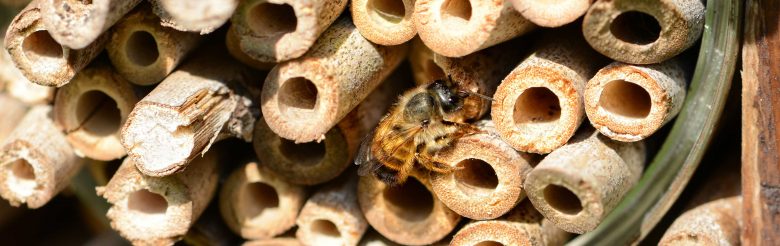
When it comes to bees, honey bees get all of the street cred, but what if I told you that there is another type of bee that is even more valuable when it comes to pollination and, wait for it…you’d be hard-pressed to get them to sting you? I know. Mind blown. Introducing…solitary bees.
Solitary bees are the chill loner cousins of the more popular honey or bumble bees. They live a (short) life of havin’ babies and eating nectar. They aren’t about that hive life and can’t be bothered with honey making and queen protecting. Actually, every female solitary bee IS a queen in her own right (yaaas, girl). The males? Well, they die right after mating (sorry, dudes). All of that translates into docile little pollinating machines because they don’t have anything to protect and their only real mission in life is reproducing. Their badassedness at pollinating is just a byproduct of them trying to go from flower to flower as quickly as possible to pack a lunch for their wee babies to be(e). No, really. It goes a little something like this:
- Male solitary bees chew their way out of their cocoons.
- They roam free looking for nectar to build up that stamina because soon the ladies will arrive and then…insert Marvin Gaye song here.
- When the ladies make their entrance, they find all the boys in their yard nearly salivating over their arrival.
- Enter birds and bees…the males die.
- The ladies, having chosen the perfect tube-like residence to form a nursery in, set out to dip a little nectar and bring some pollen back to the nursery. In doing so, she does us a solid by tracking all the pollen attached to the hairs on her body from flower to flower.
- She creates sections within the nursery. Each section is separated by mud (mason bees), leaf/flower remnants (leafcutter bees), or other species-specific accouterment. In those sections, you’ll find her lovingly packed pollen lunch and an egg. She lays females towards the back of the nursery and males toward the front. Yeah. She can determine the sex of the babies. She’s a boss.
- This continues until she’s got no eggs left to lay or she dies.
- Larva sup upon their lunch, spin their own cocoon, and take a wicked power nap until their species (and temperature) determined awakenings.
And that’s the circle of life for the solitary bee. But, wait, there’s more…
- 1 solitary bee has the pollination power of about 120 honey bees.
- Males are physically unable to sting and females will only sting if, well, you squish them. Can you blame them? A solitary bee’s sting is also comparable to a mosquito bite and is not known to cause anaphylactic shock.
- Keeping solitary bees near your garden can help triple its harvest as well as up the pollen supply for rapidly declining honey bees.
- Solitary bees will only travel about 300 feet from their nest, while honey bees will travel 4-5 miles from their hive. This reduces the chance of bringing unwanted pesticides back from other pollen sources as well as helping to ensure that more of your garden is pollinated versus your entire neighborhood.